
Emergency Air Duct Cleaning Near Me: What Gravesend Homeowners Should Do First
If you’ve just had a basement flood or a small kitchen fire and your HVAC is still running, turn it off right now. That single step is more important than anything else you can do in the next half hour, because every minute the system operates is spreading whatever entered the ducts to every room in the house. Shut the thermostat to OFF, not just “fan auto.” Then work through the steps below. If you’d rather not handle the shutdown yourself, call (844) 917-3975 and we’ll walk you through it.
Key Takeaways
- Kill the HVAC at the thermostat and at the breaker before you do anything else.
- Seal supply and return registers with tape to contain what’s already in the system.
- Photograph everything before you clean a single surface – it speeds up assessment and helps with an insurance claim.
- True emergencies (sewage, fire soot, rodent nesting, visible mold) need HEPA collection and EPA-registered biocides, not a standard blow-and-go visit.
- Ask for a scope call before dispatch so the right equipment shows up the first time.
What Counts as a Real Duct Emergency in Gravesend?
A real duct emergency is contamination that is actively moving through the system or poses a health or fire risk: sewage backflow into a return, smoke and soot from a fire, confirmed rodent nesting inside ducts, or mold growing on visible water intrusion. Dust buildup and a musty smell are urgent, but they aren’t emergencies – they don’t spread contamination while you sleep.
In our experience, Gravesend homeowners often conflate “my ducts smell bad” with “my house is contaminated.” Those are different problems with different timelines. Here’s how we sort them:
- True emergency: sewage has entered a return, a fire produced smoke that the blower pulled into the system, you’ve seen rodent droppings or nesting material inside a register, or you have visible mold on a duct interior or ceiling around a vent.
- Urgent, not emergency: a sudden heavy dust plume after renovation, a persistent musty odor with no visible source, or a duct that’s clearly disconnected and pulling attic or basement air.
- Routine: gradual dust buildup, a slight odor you can’t quite place, or an energy bill creeping up season to season.
If you’re not sure which bucket you fall into, that’s exactly what a scope call is for. Calling Air Duct Cleaning Gravesend and describing the event gets you a straight answer on whether you need a same-day visit or a scheduled cleaning.
The 30-Minute Shutdown Protocol for Gravesend Homes
Your job in the first half hour is to stop the spread. You are not cleaning anything yet – cleaning comes after the system is contained. Work through these steps in order.
- Turn the thermostat to OFF. Not “auto,” not “circulate.” OFF. If you have a separate air handler switch, flip it too.
- Kill power at the breaker panel. Find the breaker labeled for the furnace or air handler and switch it off. If it isn’t labeled, don’t guess – read the panel schedule.
- Seal every supply and return register. Standard painter’s tape or blue masking tape works. Avoid duct tape on painted surfaces – it pulls paint. Cover the entire grille face, not just the center.
- Close the door to the affected room if the contamination started in one area (a basement flood, a kitchen fire).
- Do not run ceiling fans or box fans in the affected area. They move the same contaminated air the HVAC was moving.
- Photograph before you touch anything. Wide shots, close-ups, and the model plate on the furnace or air handler.
If the contamination came from a fire, leave the soot alone until a technician assesses it – wiping soot can drive particles deeper into surfaces. If it’s sewage, wear gloves and don’t enter standing water near electrical equipment.
What to Document Before the Technician Arrives
Good documentation is what turns a service call into a fast, accurate assessment – and sometimes into an insurance claim. A few minutes with your phone can save a lot of back-and-forth later.
- Photos of the source event: the flood line on the basement wall, the fire damage, the rodent droppings, the mold growth. Wide shots first, then detail.
- Photos of affected registers: show the grille and the surrounding ceiling or floor, because this tells us how far the contamination likely traveled.
- HVAC make and model: photograph the model plate on the furnace, air handler, and outdoor condenser. This tells us the system layout so we bring equipment that fits.
- A timeline in writing: when the event happened, when you shut the system down, who was in the home, and whether anyone has smelled or felt symptoms since.
- Any relevant documents: the insurance policy number, your adjuster’s name if you’ve already filed, and receipts for any emergency mitigation you’ve already paid for.
Property managers and landlords in Gravesend should keep this same packet on file – it’s the difference between a fast, documented response and a week of phone tag with the insurer.
What Equipment Does a Genuine Contamination Event Actually Require?
Standard duct cleaning equipment is not enough for a true contamination event. A genuine emergency requires HEPA-filtered negative-air collection, containment barriers, and EPA-registered biocides applied after mechanical cleaning. Standard cleaning trucks carry the first piece and rarely the rest.
What separates an emergency-grade response from a routine cleaning:
- HEPA collection traps particles at 0.3 microns and above; a standard shop vac exhausts fine particulate back into the room. Abatement Technologies makes HEPA units that professional remediators use for exactly this reason.
- Containment and negative air: plastic sheeting and negative-pressure machines keep the affected zone sealed so contamination doesn’t migrate to clean rooms during the work.
- EPA-registered biocides: applied after debris removal to neutralize mold, bacteria, and allergens left behind. Guardsman products are formulated for exactly this stage, and they’re what we use on post-emergency sanitizing.
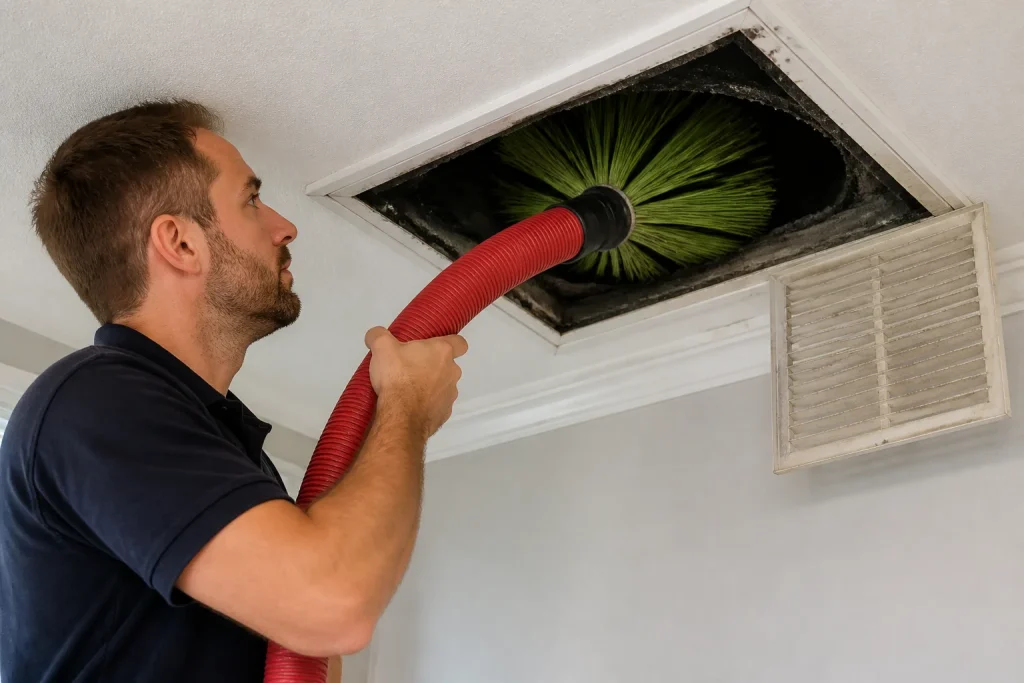
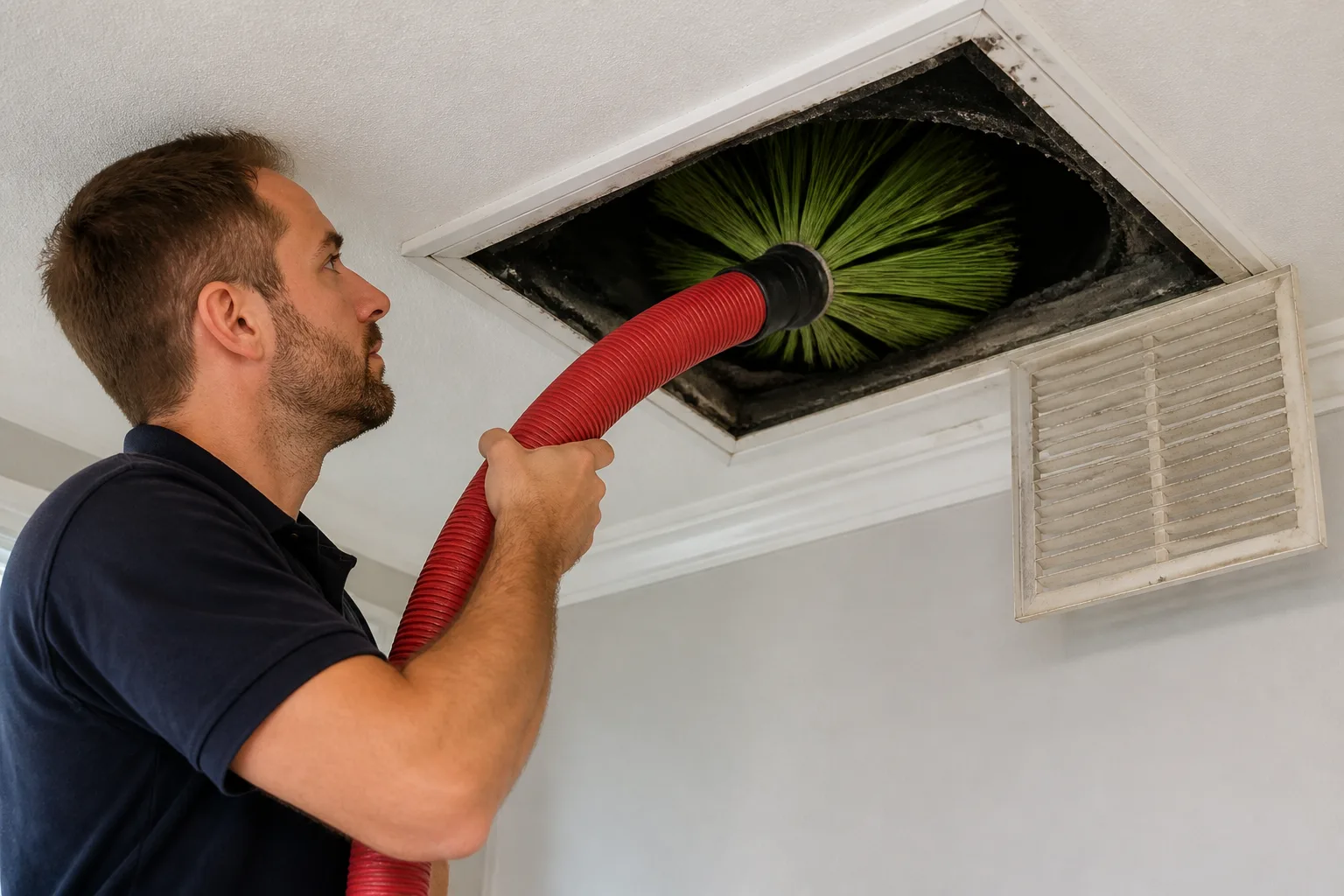
- Rotobrush and Nikro equipment for the mechanical side – the same tools HVAC contractors use on standard and heavy-soil cleaning jobs.
- Scope camera or video inspection to confirm what’s actually inside the system, not just what’s visible at the grille.
A crew that shows up with a shop vac and a wand is not equipped for a sewage or soot event. Ask what equipment is coming before you book – the answer tells you a lot.
Why You Should Ask for a Scope Call Before Dispatch
A scope call before dispatch is a five-to-ten minute conversation that determines what equipment, how many technicians, and how much time a job needs. Skipping it means a technician can arrive without the HEPA unit or the biocide a sewage or soot event requires – and then have to leave and come back, while the contamination stays in the system.
What a good scope call covers:
- What happened, when, and how long the HVAC ran after.
- What’s visible – photos help here.
- Whether the affected area is confined or whole-house.
- The age and type of the system, if known.
- Whether the homeowner has filed an insurance claim.
In our experience, the difference between a same-day visit that solves the problem and one that turns into a two-visit ordeal almost always comes down to whether the scope call happened first. When you call for emergency air duct cleaning in Gravesend, ask for the scope call – a serious provider will offer it without being asked.
When to Call a Pro (and When to Just Schedule)
Call us directly if the contamination source is sewage, fire soot, confirmed rodents, visible mold, or if anyone in the home has asthma or a respiratory condition and the ducts are suspect. Call now, don’t wait for a scheduled appointment – because the difference between containing contamination in the first hour and letting it spread for a week is measurable.
If the issue is a slow dust buildup, a musty smell without a visible source, or a duct system you’ve never had cleaned in a home you just bought, schedule a standard visit. That’s not an emergency – that’s maintenance, and it costs a lot less than a contamination response.
While a technician is on site for a contamination event, it’s also the right moment to check the dryer vent if it hasn’t been serviced recently. A clogged dryer vent is a leading cause of residential fires, and a scope visit is the cheapest opportunity to address it. We handle that under dryer vent cleaning as part of the same visit.
Related services in Gravesend: if the contamination source is inside the HVAC cabinet itself – a wet coil, a blower wheel coated in soot – the fix isn’t just the ducts. That’s HVAC cleaning, and it’s often the step that resolves the odor coming back after a duct cleaning.
The Bottom Line
Duct emergencies in Gravesend come down to three moves: kill the HVAC, seal the registers, and document everything before you touch a surface. Do those three things in the first thirty minutes and you’re already ahead of most homeowners facing the same situation. After that, a scope call tells you whether you need a same-day contamination response or a scheduled cleaning – and asking the right question up front saves days.
If you’ve had a fire, a sewage event, or found evidence of rodents in your ductwork, don’t run the system until it’s been assessed. Call (844) 917-3975. We answer 24/7, and fast dispatch from 7am to 7pm, Sunday through Friday gets a technician to your door with the right equipment the first time.
If you’re in Gravesend and need help, Air Duct Cleaning Gravesend offers free estimates – call (844) 917-3975.
Frequently Asked Questions
Turn off the HVAC at the thermostat and the breaker panel, then seal supply and return registers with tape. Those two steps stop the spread of contamination while you wait for professional help. Call (844) 917-3975 for an exact quote – estimates are free.
There’s no honest single number, because a contamination response is priced per job based on the system size, the contamination type, and the equipment required – and a scope call has to happen first. What we can say is that the estimate is free and the price is set per job, agreed before work begins. Call (844) 917-3975 for an exact quote.
No. Running the system after a contamination event pushes whatever entered the ducts into every room of the house. Turning the HVAC off is the single most important thing you can do in the first thirty minutes. Call (844) 917-3975 for an exact quote – estimates are free.
Usually because they aren’t bringing HEPA collection, containment barriers, or biocides – just a shop vac and a wand. That’s fine for routine dust, but it does not address sewage, soot, or rodent contamination. Ask what equipment is coming before you book. Call (844) 917-3975 for a straight answer on what your job actually needs.
Written by the team at Air Duct Cleaning Gravesend.
Need Air Duct Cleaning Help?
Call Air Duct Cleaning Gravesend - the local pro we connect you with is licensed and insured, with free written estimates in Gravesend.
(844) 917-3975